
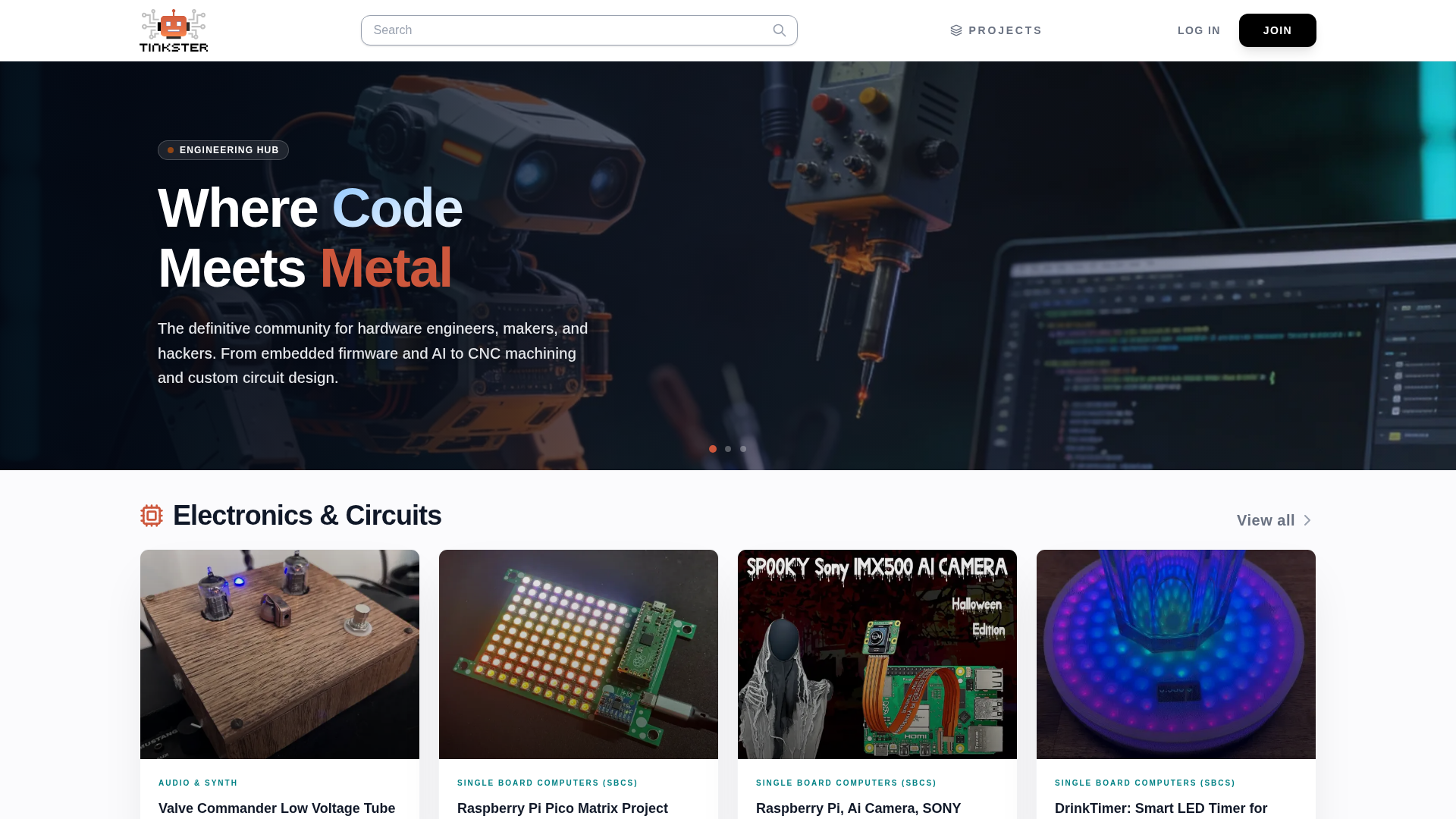
Tinkster is the definitive online community for hardware engineers, makers, and hackers. It serves as a central resource for projects, guides, and discussions spanning embedded firmware, artificial intelligence, CNC machining, and custom circuit design.
This platform is specifically designed for hardware enthusiasts, hobbyists, and professionals looking to explore, learn, and contribute to the world of physical computing and digital fabrication.
Key Features
Comprehensive project showcases across diverse engineering disciplines, from audio synthesis to animatronics.
Detailed DIY guides and tutorials, often including code examples and step-by-step instructions.
Community-driven content fostering knowledge sharing and inspiration among members.
Coverage of cutting-edge topics such as AI, IoT, and advanced manufacturing techniques.
Well-categorized content for easy navigation, covering Electronics, SBCs, Coding, Robotics, Digital Fabrication, and Workshop tools.
Use Cases
Learning & Project Development: Tinkster is an excellent resource for expanding practical engineering skills. Users can find step-by-step guides to build projects like a DIY oscilloscope, animatronic eyes, or a smart LED timer, catering to both beginners with Raspberry Pi or ESP32 and experienced makers seeking advanced challenges in areas like ROS 2. It's a rich source of inspiration for new hardware and software projects, encouraging innovation and providing a foundation for unique creations.
Technical Problem Solving: When facing specific hardware or software challenges, users can leverage the platform's extensive content to find solutions. Whether optimizing Raspberry Pi performance with Docker, designing custom cooling for microservers, or understanding Fusion 360 CAM, Tinkster offers practical insights and technical details for real-world applications, helping users overcome obstacles in their projects.
Pricing Information
Based on the provided information, Tinkster appears to be a free-to-access community platform, focusing on content sharing and project showcases. No explicit pricing models, subscriptions, or premium features are mentioned.
User Experience and Support
The platform's content is logically organized with clear subheadings and categories, suggesting an intuitive and easy-to-navigate user interface. The presence of numerous "Guides" and "Tutorials" indicates a strong commitment to providing comprehensive documentation and learning resources. As a "definitive community," it implies users can find assistance and engage in discussions with fellow members.
Technical Details
Tinkster covers a broad spectrum of technologies relevant to hardware and embedded systems. Projects frequently feature popular microcontrollers and single-board computers such as Raspberry Pi, Arduino, and ESP32. Software and frameworks mentioned include MicroPython, ROS 2, Docker, Home Assistant, ESPHome, and Gemini AI. Digital fabrication tools like CNC routers, laser cutters, and 3D printing (with Fusion 360) are also prominently featured.
Pros and Cons
Pros:
Diverse range of hardware and software projects with practical guides.
Strong focus on DIY, open-source technologies, and community contributions.
Covers both beginner-friendly and advanced technical topics.
Excellent source for project inspiration and skill development.
Cons:
No explicit mention of interactive forums or direct support channels.
Content quality might vary as it is community-driven.
Some advanced projects may require prior technical knowledge.
Conclusion
Tinkster stands as an invaluable online resource for anyone passionate about hardware engineering, offering a wealth of projects, detailed guides, and technical insights. It's a vibrant space where innovation thrives and knowledge is shared, truly embodying the spirit of "where code meets metal." Dive in to explore, learn, and contribute to this dynamic community.
Comments
Publisher

Launch Date2026-07-13
Platformweb
Pricingfree
Tech Stack
#Next.js#Payload CMS#Docker#AlmaLinux
Sponsors

AIChatOne
All-in-one AI assistant with the most advanced AI models to help you Chat, Search, Write, Read and more.
Become a Sponsor
Get your brand featured here
Outbid
View🥇 🥈
🥈 🥉
🥉
Want this spot? Pay what you wantBoost Domain Rating - Boost Domain Rating is a platform to discover and upvote the best tech products. Find top products launching daily.
Boost Domain Rating is a platform to discover and upvote the best tech products. Find top products launching daily.
$35
DirEasy - The Best Directory Boilerplate with AI | DirEasy
The best directory boilerplate, packed with AI, Listings, Payment, Submission, CMS, Blog, Authentication, Newsletter, SEO and more.
$30
Quiz Shot - Solve Any Screenshot Question in Seconds.
AI Study Assistant that answers any screenshot question. Get free AI tutor and step-by-step math and homework help with ChatGPT.
$25