CompeteScan Review - See If AI Recommends You or a Rival
Welcome to our CompeteScan review.
Somebody in a sales call last month said they had found us through ChatGPT. That should have felt like good news. Instead it set off the question I could not answer: what does ChatGPT say when someone asks about our category and does not use our name? Search Console will not tell you. Your rank tracker will not tell you. The page can sit at position one in Google and the assistant can still recommend three other companies.
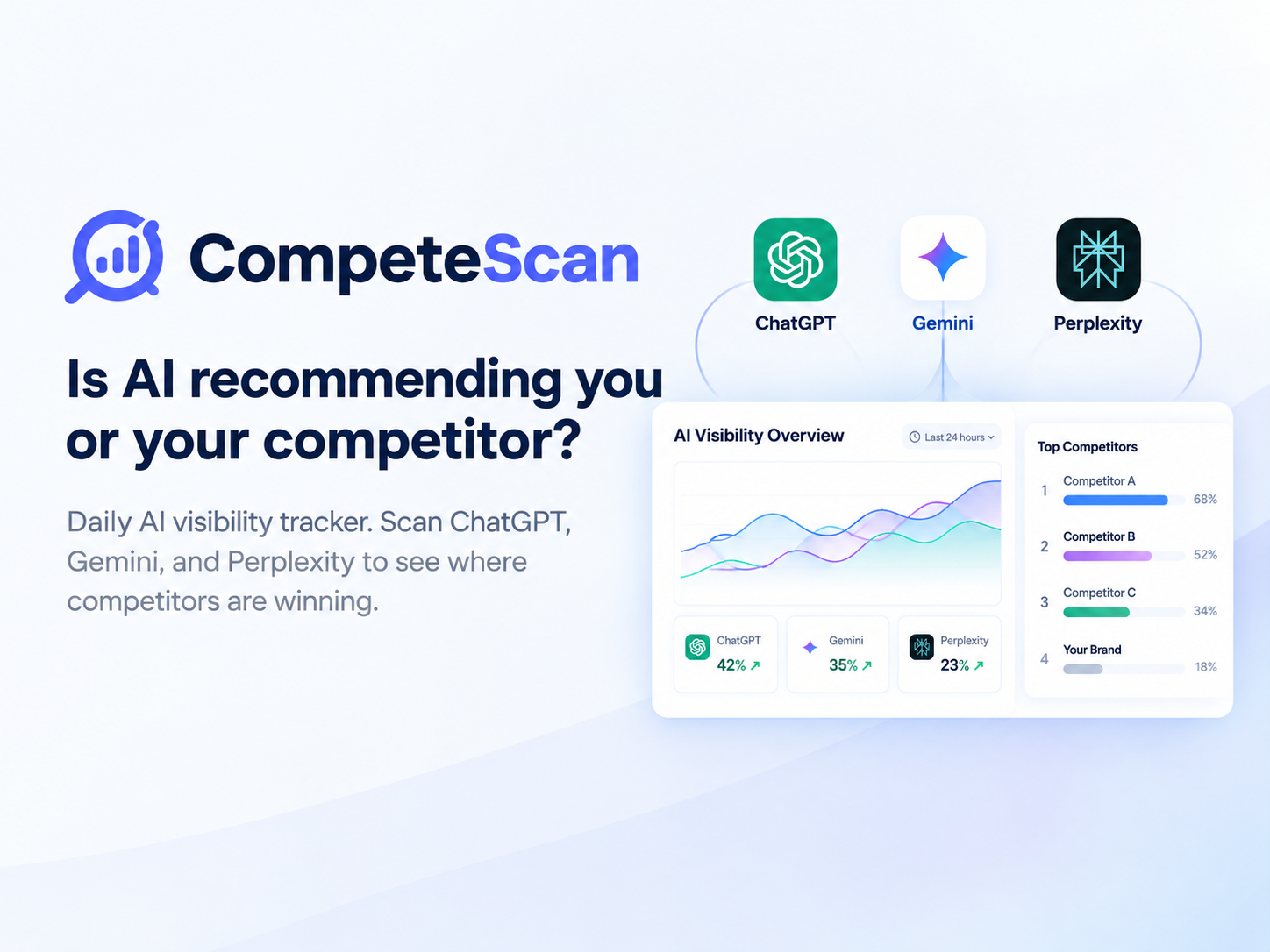
That is the exact gap CompeteScan is built to close. It checks whether ChatGPT, Gemini and Perplexity recommend you or your competitors, shows the answers and the sources behind them, and then hands you a ranked list of fixes. Everything in this review comes from what CompeteScan publishes about the product: the homepage, the pricing table, the FAQ, and the comparison piece it runs on its own resources pages. I have not run a paid trial, so treat this as a careful read of a documented product, not a lab test. The free scan, however, is a real thing you can run yourself in about a minute, and I will come back to what it does and does not show you.
What CompeteScan Is
CompeteScan is an AI visibility tool. It answers one question in a fairly blunt way: when buyers ask an assistant what to buy, who gets named?
Under the hood it does four things:
- Detects your real competitors from your domain, rather than asking you to type a list from memory.
- Asks all three engines the questions your buyers actually ask, with search turned on, so every answer comes back with its sources.
- Records your rank on each prompt, the exact answers each engine gave, the pages it cited, and how your share of AI answers moves week over week.
- Ends in a playbook of fixes sorted by leverage, so the output is a to do list rather than a dashboard you have to interpret.
The category has a few names. Some people call it AEO, for answer engine optimization. Others call it generative engine optimization, or GEO. CompeteScan's own FAQ treats the two as the same job: getting your brand named and cited inside AI answers. Traditional SEO still describes the Google blue links side of things. This tool measures the other half, and its author is upfront that it is not a replacement for keyword rank tracking.
One thing to clear up early, because it comes up in the FAQ: CompeteScan is not an AI writing tool. It does not generate blog posts or spin existing articles. It queries answer engines, scores share of voice, shows citations and returns a ranked plan. Whatever content gets written or pitched afterwards is still your job.
Why This Category Exists At All
If you are still in the "nobody buys through chatbots" camp, the numbers CompeteScan cites are worth a look. It points to Statcounter data from August 2026 on how AI chat assistants split referral traffic, and the shape of it is what matters:
| Engine | Share of AI chat referrals |
|---|---|
| ChatGPT | 79.4% |
| Gemini | 10.9% |
| Perplexity | 4.31% |
| Everything else | 5.4% |
Read those three engines together and you are looking at roughly 95% of the traffic that leaves an assistant and lands on a website. The practical conclusion CompeteScan draws is that a tracker which only checks ChatGPT is leaving the rest of the shortlist unmeasured. It is also the reason its own free scan is limited to one engine, and the reason the paid entry tier exists.
The second half of the argument is about how answers are built. Recommendation answers are assembled from a small set of pages the model trusts for that question: a review site, a comparison roundup, a forum thread, a video. Change those sources and you change the answer. Most visibility dashboards stop at the mention count and never show you the pile of pages underneath it. That is the seam CompeteScan aims at.
How the Free Scan Works
The whole flow is three steps and no credit card.
- Enter your domain. CompeteScan reads your positioning and works out who your real competitors are. No prompt setup, no site access, no plugin.
- It queries the engines. The free scan starts on ChatGPT. Gemini and Perplexity are added on Starter and above.
- You get a report and a playbook preview. Five tracked prompts, a visibility report, and the first pass of the fix list.
CompeteScan quotes about 60 seconds for the scan, which matches what a quick check of the live form suggests. What you get for free is narrow on purpose: five prompts on one engine. It is a diagnosis, not a monitoring service. Still, five real buyer questions asked of ChatGPT, with the sources attached, tells you in a minute whether this problem applies to you. For most people reading this, it does.
See CompeteScan in Action
If you would rather watch before you scan, the intro video is a useful three minutes. It walks through the same concepts this review covers, in the same order: prompts for the buyer questions you track, competitors for who is winning those answers, and the playbook for the ranked fixes that close the gap. It also goes over engine coverage, what the team calls the retrieval funnel, and the collaborative features on the paid plans.
Core Features
Visibility Trend
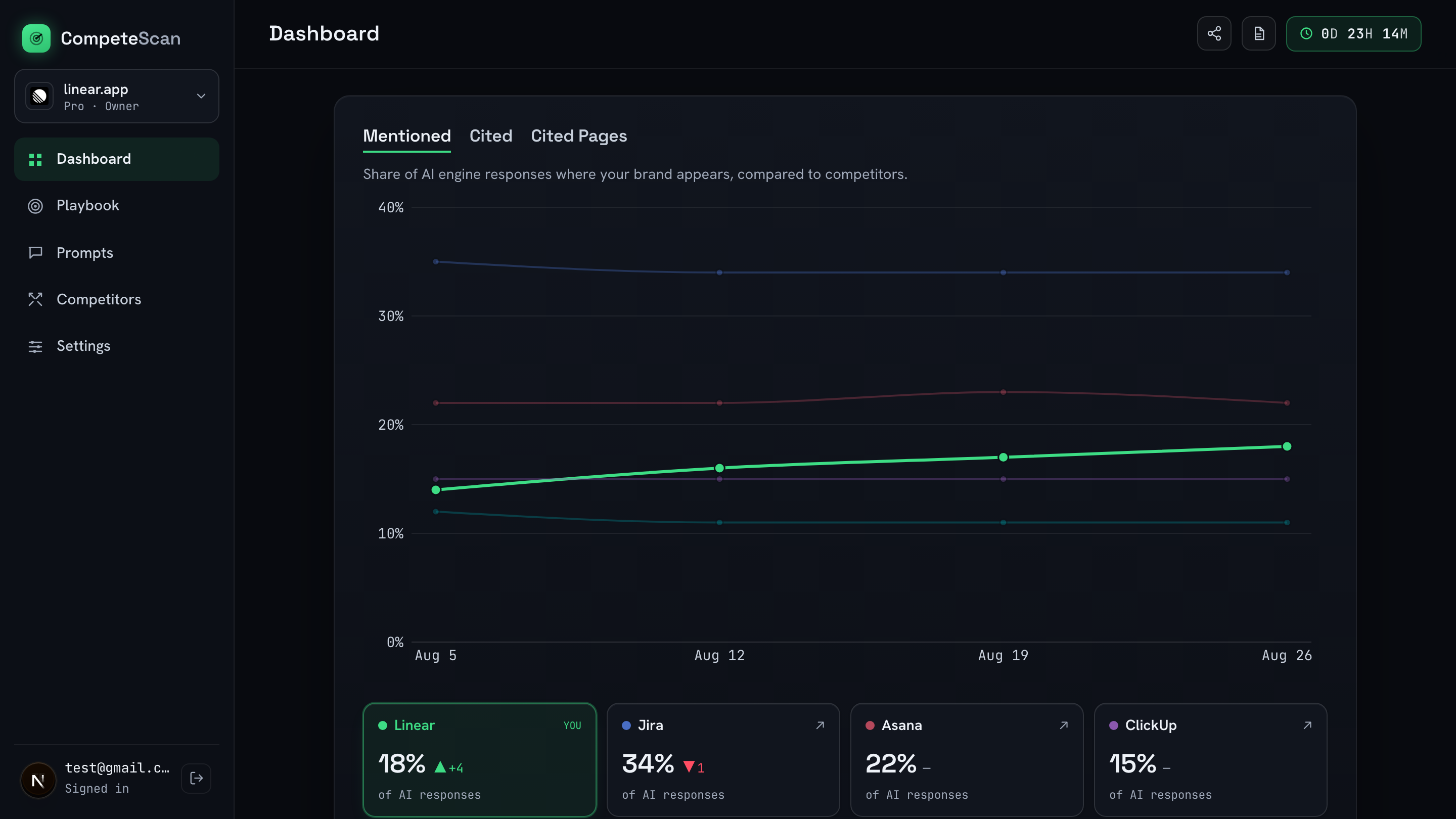
This is the week over week view of how often ChatGPT, Gemini and Perplexity mention and cite you. The point is not today's number, it is the direction, and especially the moment a competitor starts gaining on you while you are not looking.
CompeteScan's own sample chart makes the argument better than prose does. Over six weeks of a project management category run, Linear climbs 37% in AI mentions while Jira slips 9 and Asana drops 5. Three brands, one category, three different trajectories. If you were at Jira, you would want to know that in week two rather than at the end of the quarter.
Rank Matrix
The rank matrix is a grid of you and your competitors against every prompt being tracked, so you can see at a glance where you are winning and where you are simply absent. The sample prompts CompeteScan runs in its own demo are exactly the kind of thing a buyer types:
- best tool for agencies
- jira alternative
- ai project management
- tool with github sync
- roadmap software
In the example results, Jira takes #1 on several of those prompts while Linear shows N/A on others, meaning it was not named at all. That distinction matters more than a single score. Missing from an answer entirely is a different problem from being named third behind two rivals, and the matrix separates them for you.
Real Answers
For any prompt you are losing, you can open the answer each engine actually gave. Not a summary, not a score: the response text, with your brand and your competitors marked as Mentioned and their position in the answer, #1, #2, #3.
This is the feature that makes the rest credible. Visibility numbers get argued about in meetings. A screenshot of ChatGPT recommending a competitor, with the prompt that produced it, does not.
Win Analysis
Win analysis explains why the assistant picked the other company. It pulls apart the sources the model relied on and shows where the gap is.
The example on the CompeteScan site is Jira dominating "best tool for agencies". The explanation it gives is concrete: Jira appears in nine G2 category roundups built around agencies, and Reddit threads repeatedly name it when people ask the same question. So the model has a stack of corroborating sources. If you want that slot, you either get into those roundups or you build something they quote instead.
That is a much better starting point than "improve your content and authority", which is what most advice in this space boils down to.
The Playbook
Every report ends in a playbook, and this is where CompeteScan spends most of its positioning. Instead of a generic checklist, you get specific fixes ranked by leverage, each tagged by type and given a priority score.
The sample playbook from the Linear run looks like this:
| Fix | Leverage | Type |
|---|---|---|
| Publish a "Linear for agencies" comparison page | Top ▲9 | Content |
| Earn a spot on 3 G2 category roundups | ▲8 | Citations |
| Add a GitHub-sync integration page | ▲7 | On-site |
| Seed answer-ready FAQ content for buyers | ▲6 | Content |
Four fixes, a running progress counter at 2 of 4 done, and a clear order. What I like about the structure is that it names three different kinds of work and does not pretend they are equal: content you can publish this week, citations that take a quarter, and on site pages that take an afternoon. Sort them by leverage and a small team knows where to start.
Citation Tracking and Alerts
Citation source tracking is included on every paid plan, which is worth noting since it is the part that tells you which pages to target. Alerts, both email and in app, start at Pro. Starter does not include them, which is the one feature gap I would think hardest about before choosing a tier. If the whole point is catching a competitor starting to overtake you, finding out on your next manual visit is a weaker version of the product.
API access sits at Agency level, along with unlimited brands and priority support. That is the tier built for agencies running many clients rather than a single brand.
AI SEO and GEO: Where This Fits
A fair question is whether any of this belongs next to your existing SEO work, or replaces it. CompeteScan's answer, and mine, is that it sits beside it.
Regular SEO and AI SEO share raw material. Both reward being the clearest answer to a specific question, and both are helped by third party sources that vouch for you. What changes is the delivery surface. A search result is a link with a title. An AI answer is a paragraph that names two or three companies and explains why, with the sources listed underneath. You can rank first for a keyword and be absent from the paragraph, and that is not a contradiction, it is two different systems picking winners.
If you are trying to work out how much generative engine optimization you actually need, there is a practical test. Take five questions your buyers ask before they make a decision, run them through an AI visibility tool, and look at who gets named. If your brand is in all five answers, you have a maintenance job. If it is in none of them, you have a category entry problem, and it is worth finding out before a competitor becomes the default answer in your category.
CompeteScan Pricing
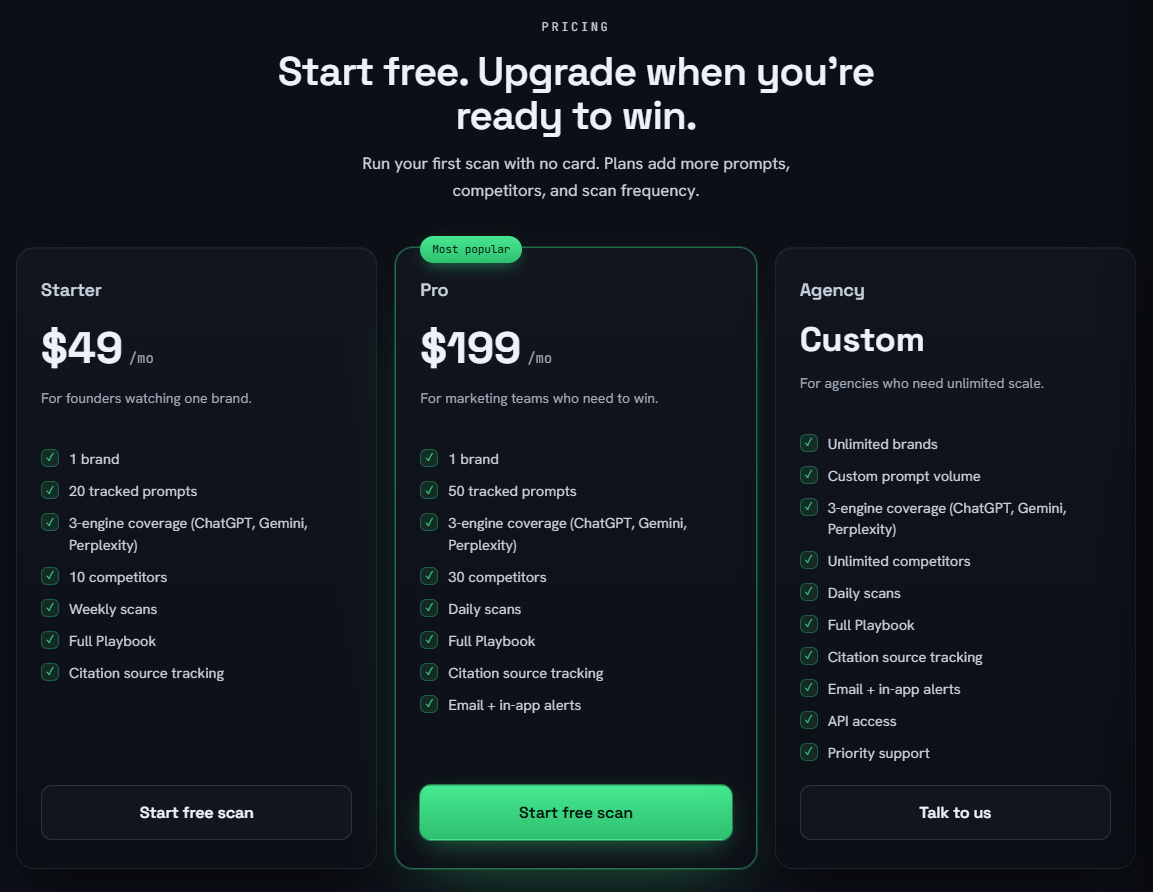
Prices listed on the CompeteScan pricing page at the time of writing:
| Plan | Starter | Pro | Agency |
|---|---|---|---|
| Monthly | $49 | $199 | Custom quote |
| Annual | $490/yr | $1,990/yr | Custom |
| Best for | Founders watching one brand | Marketing teams who need to win | Agencies at unlimited scale |
| Brands | 1 | 1 | Unlimited |
| Tracked prompts | 20 | 50 | Custom |
| Competitors | 10 | 30 | Unlimited |
| Engines | ChatGPT, Gemini, Perplexity | ChatGPT, Gemini, Perplexity | ChatGPT, Gemini, Perplexity |
| Scan frequency | Weekly | Daily | Daily |
| Full playbook | Yes | Yes | Yes |
| Citation tracking | Yes | Yes | Yes |
| Email and in app alerts | No | Yes | Yes |
| API access | No | No | Yes |
| Priority support | No | No | Yes |
A few notes from reading the table:
- All three engines are in every paid tier. Gemini and Perplexity are not upsells, which is refreshing in a market where engine coverage is often the thing being rationed.
- The free scan is genuinely free, no card, five prompts on ChatGPT, plus a playbook preview.
- Annual billing saves two months according to the pricing toggle, which puts Starter at $490 a year and Pro at $1,990.
- Alerting starts at Pro. If you want to be told when something moves rather than checking, that is the tier to look at.
- Pro is still one brand. The jump to multiple brands goes straight to Agency, so shops with several clients are effectively being quoted, not tiered.
- Paid plans carry a 14-day money-back guarantee, and you can cancel anytime.
The paid tiers also add PDF exports and team access, which matters when a report needs to reach a client or a manager who will never log in to the dashboard themselves.
How CompeteScan Compares With Other AI Visibility Tools
CompeteScan published its own comparison of the space in September 2026, and it is more useful than most vendor tables because it explains what each tool is for instead of pretending there is one winner. The prices below are the ones listed on that page, taken from each vendor's public pricing page on 2026-09-10.
| Tool | Entry price | Entry tier engine coverage | Prompt limit | Frequency |
|---|---|---|---|---|
| CompeteScan | Free, then $49 | Free: ChatGPT. Starter: all three | 5 free / 20 / 50 | Free one off, weekly, daily |
| Semrush AI Visibility | $99/mo | ChatGPT, Google AI, Gemini, Perplexity | 25 custom prompts per day | Daily |
| Ahrefs Brand Radar | $129/mo | Broad, including Copilot and AI Overviews | 5 on Lite | Daily on paid |
| Profound | $99/mo | Starter: ChatGPT only, more on Growth | 50 on Starter | Daily |
| Peec | $95/mo | Any 3 models | 50 | Not published |
| Otterly | $29/mo | ChatGPT, AI Overviews, Perplexity, Copilot | 15 on Lite, by country | Daily |
A Quick Introduction to Each Competitor
The full write up is worth reading if you are shortlisting, but here is the short version of each alternative:
Semrush AI Visibility Toolkit, $99 per month. An AI module bolted onto an SEO suite most buyers already pay for. It mentions ChatGPT, Google AI, Gemini and Perplexity, runs 25 custom prompts a day on the base plan, and adds an AI readiness site audit that sits next to your Google rank tracking. There is no free trial, and scheduled reports are paid add ons at $10 per month on Base and $20 on Pro.
Ahrefs Brand Radar, $129 per month. Mention, citation and cited page tracking, built for people already living inside Ahrefs. The entry tier lists the widest engine range of the group, covering Copilot, AI Overviews and AI Mode alongside the big three. The catch is the prompt cap: Lite tracks 5 AI prompts, Standard 10 and Advanced 20. There is also a free visibility checker, though it is a preview rather than a playbook.
Profound, from $99 per month. An enterprise AEO platform with agents and content tools, dashboard first on the public plans. Starter covers ChatGPT only, with 50 unique prompts. Three engine coverage starts at Growth, which lists at $399 per month billed yearly.
Peec, $95 per month. Pick any three models, track 50 prompts, and get recommended actions with gap analysis as a listed product area. Scan cadence is not published on its pricing page, which makes it harder to compare against tools that spell it out.
Otterly, from $29 per month. The cheapest daily monitor here. Lite covers ChatGPT, Google AI Overviews, Perplexity and Copilot, and Gemini is a $9 add on that takes the total to $38. Prompts are capped at 15 and counted per country, with no extra packs sold on Lite. Recommendations are a three a week preview that only switches on after 15 prompts, 3 competitors and 3 days of data, and the full queue starts at Standard for $189 per month. There is a 7 day trial with no card.
Who Should Skip Which Tool
The most useful part of that page is that it tells you when to walk away:
- Skip Profound Starter if you need Gemini. Its own grid lists ChatGPT only at $99 per month.
- Skip Otterly Lite if Gemini is non negotiable and you would rather not buy add ons, or if you need a complete playbook instead of a preview.
- Skip the Semrush Toolkit if you do not already need Semrush for Google. Base is $99 per month, 25 prompts, no free trial, and scheduled reports cost extra.
- Skip Ahrefs Brand Radar as your only tool if you are not in Ahrefs. Lite is $129 per month for 5 tracked prompts, and the free checker stops short of a playbook.
- Skip CompeteScan if your only question is where you rank on Google. It does not replace keyword rank tracking, and it does not pretend to.
Two things make this comparison more useful than most vendor content. It publishes sample reports from its own Pro scans, Linear and Coinbase, rather than stock screenshots, and it sets a sensible bar for the category: if a page only sells you a dashboard, keep shopping. Worth asking of any tool here whether you can see mention versus cite, named competitors, and a next action. That said, a vendor comparison is still a vendor comparison, so check the pricing pages yourself before you commit.
If you want to see what a finished report actually looks like rather than reading about it, CompeteScan publishes a real one in the open: a sample AI visibility report. It is a genuine run, not a mocked up screenshot, so you can inspect the visibility scores, the cited sources underneath each answer, and the ranked playbook before you enter a domain of your own.
Who CompeteScan Is For
The pricing page splits its audience three ways, and it is a fair split:
- Founders watching one brand, who need a baseline and a short list of fixes rather than a monitoring service. Starter.
- In house marketing teams that need to win, where weekly is not fast enough and someone has to be told when a competitor starts taking over. Pro.
- Agencies at unlimited scale, running many brands off one system, often with their own reporting layer. Agency, with API access.
From the review angle, the three groups that will get the most out of it are:
- Agencies and consultants who need a defensible audit in week one and progress proof in month three. The scan needs no site access, so you can start on a client the day they ask the awkward question.
- B2B SaaS and ecommerce teams where buyers run comparisons and roundups through an assistant before they ever visit a pricing page.
- SEO and growth teams being asked by management to explain AI search, who need prompt level evidence rather than a theory.
CompeteScan Pros and Cons
What I like:
- The report ends in a ranked playbook, with fix types and leverage scores, so it produces a work list instead of another dashboard.
- Real answers and citations are exposed per prompt, which is what makes the numbers arguable in a meeting.
- Competitor detection is automatic from your domain, so setup is a single input rather than a research project.
- All three engines are included from the $49 tier, not rationed.
- The free scan is a real, no card diagnostic that takes about a minute.
- No installation, no plugin, no site access, which means agencies can onboard a client instantly.
- The vendor's own comparison content is unusually willing to say when a competitor is the better fit.
What I would flag:
- Alerts only start at Pro, and alerting is arguably the point of monitoring.
- Pro still covers one brand, so multi client shops are pushed to a custom quote.
- The free scan covers five prompts on ChatGPT only, which is a sample of a sample.
- It does not replace your Google rank tracking, and it is not trying to.
- With 20 prompts on Starter, a large catalogue cannot be tracked exhaustively at the low tier.
- Results are not guaranteed. The playbook tells you what to change; the engines decide whether it works.
What CompeteScan Does Not Do
Being clear about this saves disappointment:
- It does not write your content or do outreach. It identifies the pages, roundups, forums and videos that decide the answers. You, or your agency, still publish and pitch.
- It is not a keyword rank tracker. It tracks brand presence in AI answers rather than web page positions for keywords.
- It does not install anything on your site. No code, no plugin, no tag, no access to your analytics.
- It cannot change the model. You change what the model can find and trust, not the model itself.
- It cannot tell you the one true prompt set. The prompts you track are a judgement call, and poorly chosen prompts produce a well formatted report about nothing.
CompeteScan FAQ
What is an AI visibility tool? Software that checks how often, how prominently and in what context a brand appears in AI generated answers, plus which pages those answers were built from. AI visibility tools like CompeteScan go one step further and return actions for improving that presence.
What is the difference between AEO and GEO? They describe the same job: being named and cited in AI answers. CompeteScan treats AEO, answer engine optimization, and GEO, generative engine optimization, as two labels for one discipline. Traditional SEO still covers Google's blue links.
Which engines does CompeteScan check? ChatGPT, Gemini and Perplexity, all with search enabled so answers come back with their sources. The free scan uses ChatGPT; all three are included on every paid plan.
Is the first scan really free? Yes. Five tracked prompts on ChatGPT, a visibility report and a playbook preview, no credit card. Paid tiers add Gemini, Perplexity, more prompts, more competitors and more frequent scans.
How long does a scan take? About 60 seconds, most of which is waiting for the engines to answer.
Does CompeteScan work as an AI SEO writing tool? No. It does not write blog posts or rewrite content. It queries the engines, measures share of voice, surfaces citations and builds a ranked fix list.
How is this different from Semrush AI Visibility Toolkit or Ahrefs Brand Radar? If you already rely on either suite for Google SEO, keeping them is reasonable and their AI modules sit inside pricing you already pay. CompeteScan's argument is that you can get three engine coverage, citation tracking and a ranked playbook from $49 a month without buying a full SEO suite, and its comparison notes that scheduled reporting is a paid add on elsewhere.
Can I cancel? Yes. Cancel anytime, on monthly or annual billing, and paid plans come with a 14-day money-back guarantee, which is enough time to run the full playbook before you commit to a year.
Who is it built for? Founders tracking a single brand, in house marketing teams that need daily monitoring, and agencies that need unlimited brands and API access.
Setup and Requirements
Unusually light, and worth saying plainly. You enter a domain. CompeteScan works out your competitors, composes the prompts and starts querying. There is no code to install, no plugin, no tracking tag, no DNS change and no access to your analytics or client sites. For an agency, that removes the single most annoying step in most audit tools, which is waiting on someone else's engineering time.
The free scan gives you a first read in about a minute. Starter moves you to weekly monitoring across all three engines with 20 prompts and 10 competitors. Pro takes it to daily with 50 prompts and 30 competitors.
Final Verdict: Is CompeteScan Worth It?
The AI visibility category has an output problem. Plenty of tools will show you a share of voice chart, a mention count and a weekly email, and then leave the actual decision to you. CompeteScan's contribution is the two layers underneath the chart: here are the answers each engine gave, here are the pages those answers were built from, and here is what to do about them in priority order. That shortens the distance between a number moving and somebody being told what to fix.
The trade offs are real but modest. Alerts start at Pro, so the entry tier is a reporting tool rather than a monitoring service. Pro covers one brand, which pushes agencies toward a custom quote. The free scan is five prompts on one engine, so it is a diagnosis and not a substitute for a paid tier if you decide the problem matters. And the product deliberately stops at advice: it will not publish the comparison page or win you the G2 roundup.
Where it earns its place is the combination of a real free diagnostic, three engines at the lowest paid tier, and an output your team can act on the same afternoon. If buyers in your category are asking an assistant what to buy, and you genuinely do not know what that assistant says about you, the free scan answers that question in about a minute. That is a low cost way to find out whether the rest of the product is worth paying for.
Review Summary
- Ease of Setup: ⭐⭐⭐⭐⭐ (5/5)
- Engines Covered: ⭐⭐⭐⭐⭐ (5/5)
- Rank and Answer Transparency: ⭐⭐⭐⭐⭐ (5/5)
- Playbook Usefulness: ⭐⭐⭐⭐⭐ (5/5)
- Alerting and Monitoring: ⭐⭐⭐⭐☆ (4/5)
- Multi Brand Support: ⭐⭐⭐☆☆ (3/5)
- Pricing Transparency: ⭐⭐⭐⭐☆ (4/5)
- Value for Money: ⭐⭐⭐⭐☆ (4.5/5)
- Overall Review Score: ⭐⭐⭐⭐☆ (4.5/5)
Curious what AI says about your brand? 👉 Scan your website for free with CompeteScan and see who ChatGPT, Gemini and Perplexity actually recommend. The first scan takes about 60 seconds and needs no credit card.
Tags
# Review# CompeteScan# AI visibility tools# AI SEO# Generative engine optimization# AI visibility tracker# Answer engine optimization# GEO software# AI search visibility# ChatGPT brand monitoring# Gemini brand tracking# Perplexity tracking# AI citation tracking# Share of voice# Prompt tracking# Competitor benchmarking# AI rank tracking# Ranked playbook# Agency reporting# AEO toolFollow for new blogs
Subscribe to our blog
Subscribe to Newsletter
Subscribe to our newsletter to get the best products weekly.