MentionBird Review - AI Visibility Tracking With a Fix Plan
Welcome to our MentionBird review.
A few months ago I asked ChatGPT for recommendations in a category I know well, and it named three brands. Two were competitors, one was a brand I had never heard of, and the company I had been doing SEO for was nowhere in the answer. Nothing in Search Console explained it. The page ranked fine. It just was not part of the answer.
That gap is what MentionBird is built around. It is an AI visibility tool that runs your buyer questions through ChatGPT, Gemini, Perplexity, Claude and four other assistants every day, shows you which sources those answers were built from, and then hands you a per prompt plan for getting your brand into them.
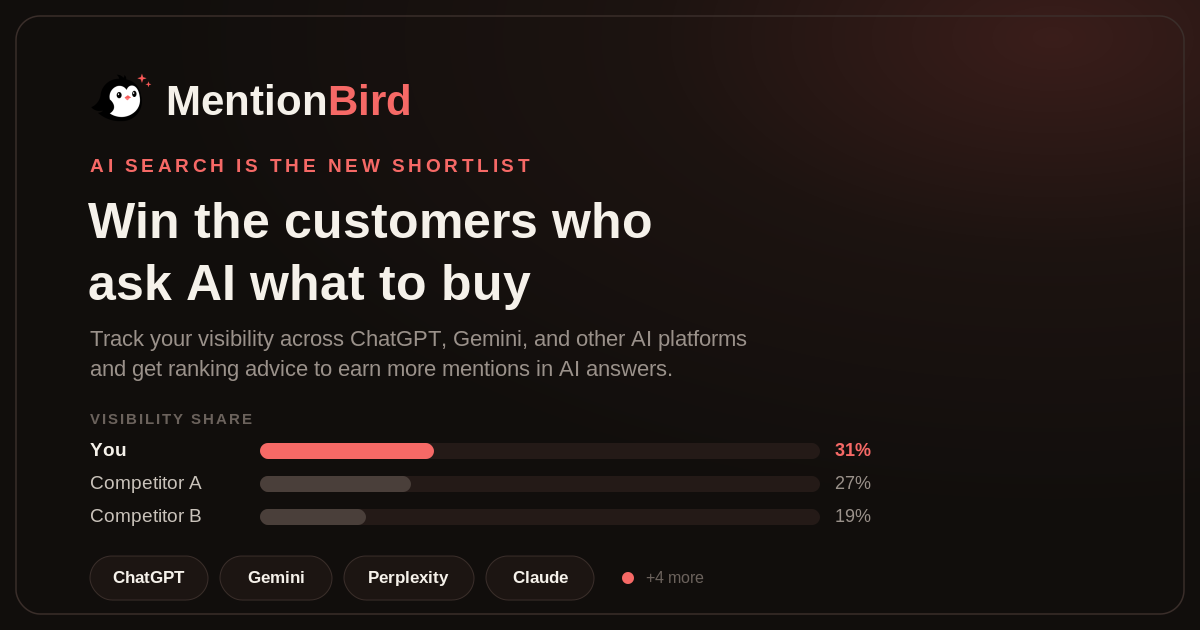
I spent time going through the product pages, the pricing page, the help content and the free tools before writing this review. Everything below comes from what MentionBird actually documents about how the product behaves, plus my read on where it fits and where it does not. No hands on trial here, since MentionBird does not offer one, so treat this as an informed read of the product rather than a lab test.
What MentionBird Is
MentionBird is an AI visibility (sometimes called AEO or GEO) platform made by ADNABU PTE. LTD. It does two things that most tools in this space only do one of:
- Prompt tracking: you give it the questions buyers ask before they buy, and it asks those questions on the AI platforms you pick, every 24 hours, then records which brands got named, how high they appeared, and which sources were cited.
- AI Ranking Advice: for any prompt you are losing, an agent reads that specific answer, pulls the sources behind it, and returns a plan with effort estimates and links to the pages it used.
The second part is the pitch. MentionBird states it plainly on the homepage: other AI visibility trackers show you a chart of mentions and leave the "now what?" to you. MentionBird tries to answer the follow up question.
The Problem MentionBird Is Trying to Solve
The company's argument runs like this, and it is hard to argue with the premise:
- The shortlist now forms inside the answer. Buyers ask an assistant what to buy and get two or three names back. If your brand is not one of them, you were not in the running, and no analytics package will ever show you the lost visit.
- Every answer has sources. Recommendation answers are built from a small set of pages, reviews and videos the model trusts for that specific question. Get into those sources and you change the answer.
- One score hides everything. A site level visibility score averages hundreds of checks. When it moves, you cannot tell which prompt moved it, on which platform, in which country.
- Zero can mean two different things. Sometimes a competitor owns the mention and you have to take it off them. Sometimes the assistant names no brand at all and the slot is free. Both show up as zero, and only one is easy to win.
- Being early still matters. The site argues most categories have no settled winner in AI answers yet, so early movers can become the default name.
Whether you buy the whole argument or not, the practical problem is real: teams currently check AI answers by hand, in their own logged in ChatGPT account, with memory and browsing settings quietly shaping the result.
Why Choose MentionBird?
- 🎯 Prompt level tracking: every tracked question has its own page with a visibility score, share of mentions, mention rate and average position.
- 🗺️ Source maps: see the exact pages, review sites, forums and YouTube videos any answer was built from, with domain authority per cited URL.
- 🧭 AI Ranking Advice: a per prompt plan that reads today's answer instead of handing you a generic site wide checklist.
- 🤖 Eight AI platforms in total, with 2 on Starter, 4 on Growth and all 8 on Custom: ChatGPT, Gemini, Perplexity, Claude, Grok, Google AI Overviews, Microsoft Copilot and DeepSeek.
- 🌍 Country targeting: point any prompt at a specific country, or leave it global, on every plan.
- 📊 Competitor benchmarks: share of voice, your rank among named brands, and up to 365 days of history.
- 🏷️ Tags: group prompts by product line, funnel stage, market or client and filter every report by tag.
- 🔌 MCP connection: connect Claude or ChatGPT directly to your MentionBird data.
- 🧰 Three free tools: a crawler accessibility checker, an AI content score, and a keyword to prompt generator, no login required.
- 👥 Built for teams and agencies: 10 team members per plan, multiple brands from Growth upward.
How MentionBird Works
The company lays out five steps on its How It Works page, using a running shoe example throughout.
Step 1: Add Your Prompts
You add your brand, your competitors, and the questions buyers ask right before choosing. MentionBird suggests starting with 20 to 50 prompts and tagging them by product line or campaign. There is no code to install and no plugin. The site says setup takes minutes.
Step 2: Read the Answer
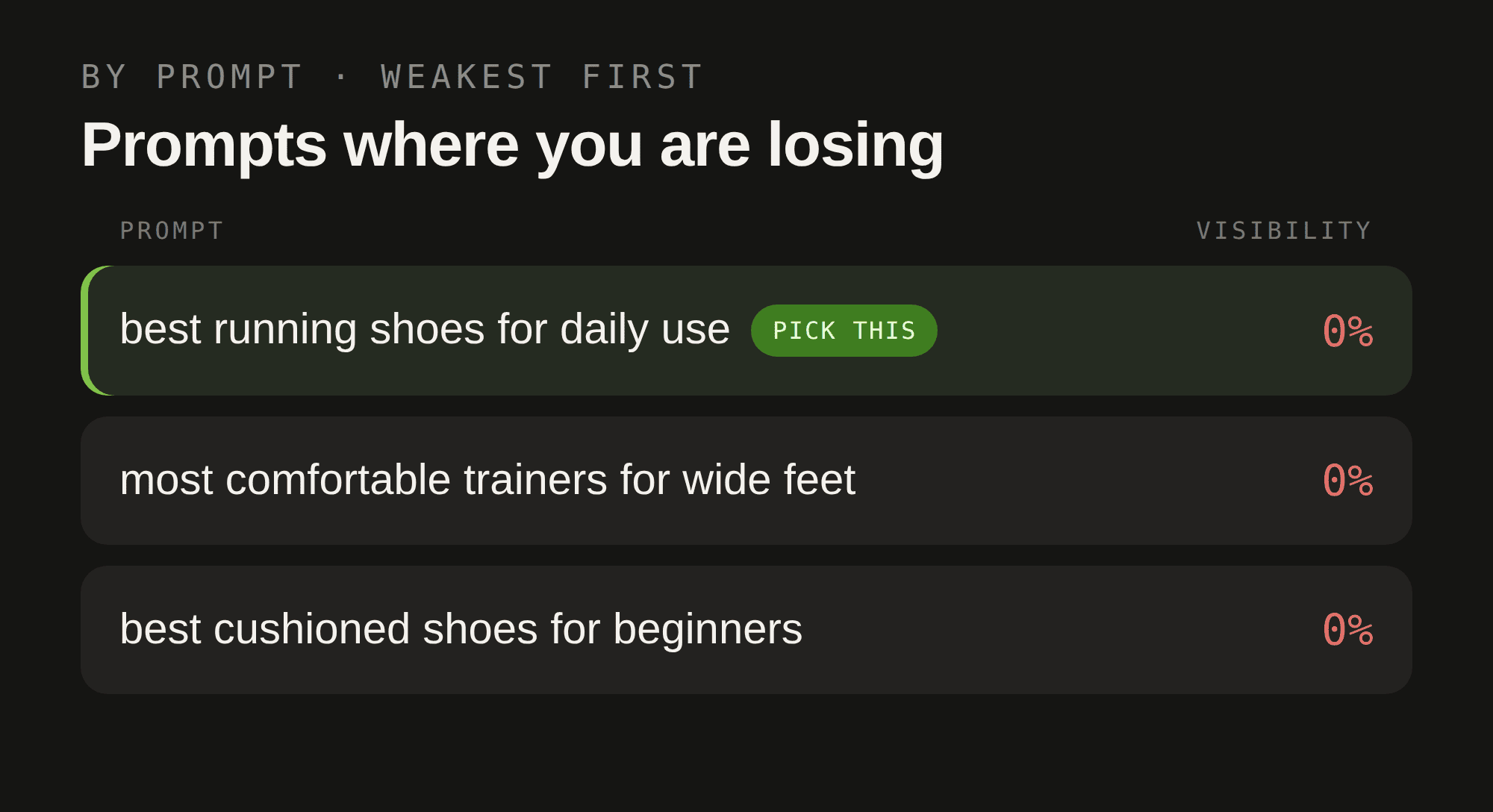
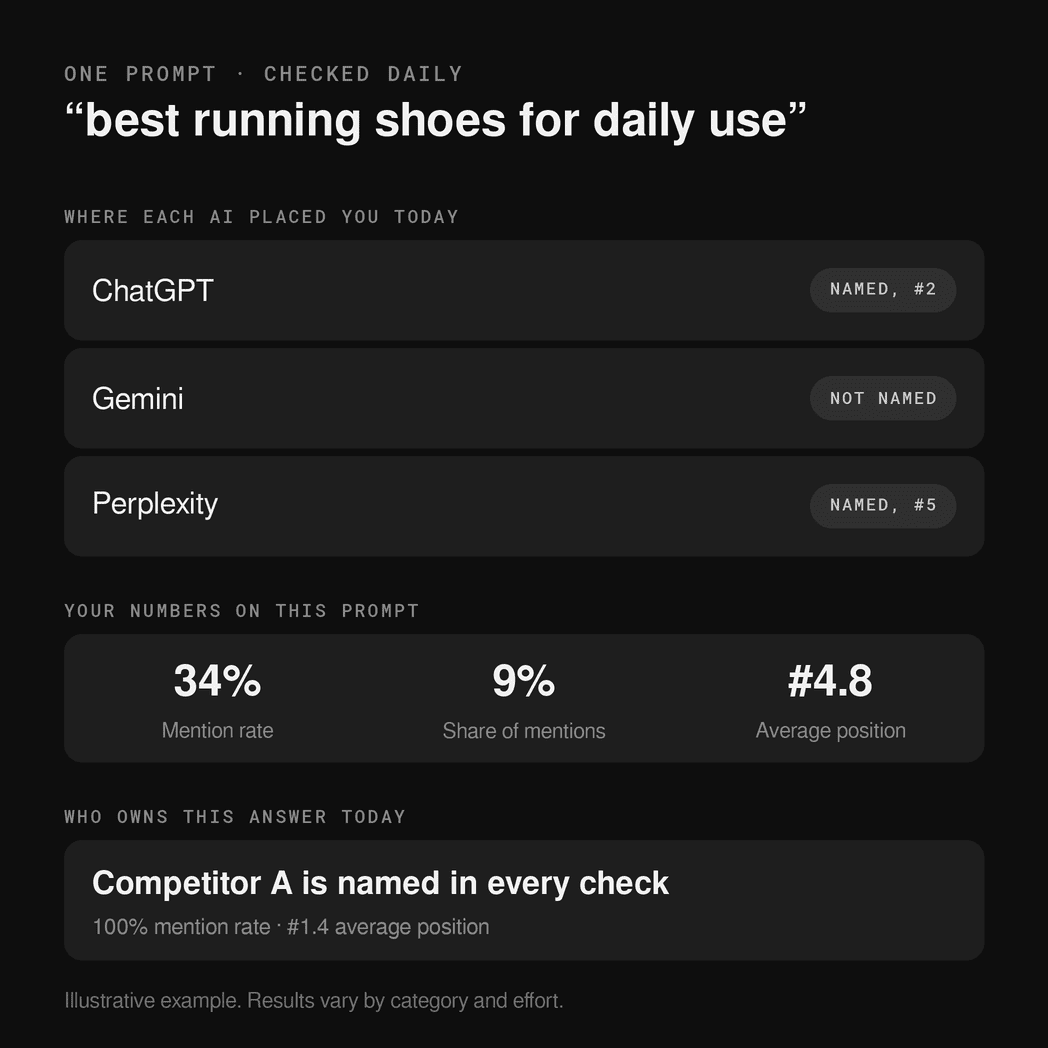
MentionBird runs those prompts daily across your chosen platforms. For the example prompt "best running shoes for daily use", the answer named three brands and the customer's brand was not one of them. That is the baseline: the gap, per prompt, per platform, with a visibility score against every competitor.
Step 3: See the Sources
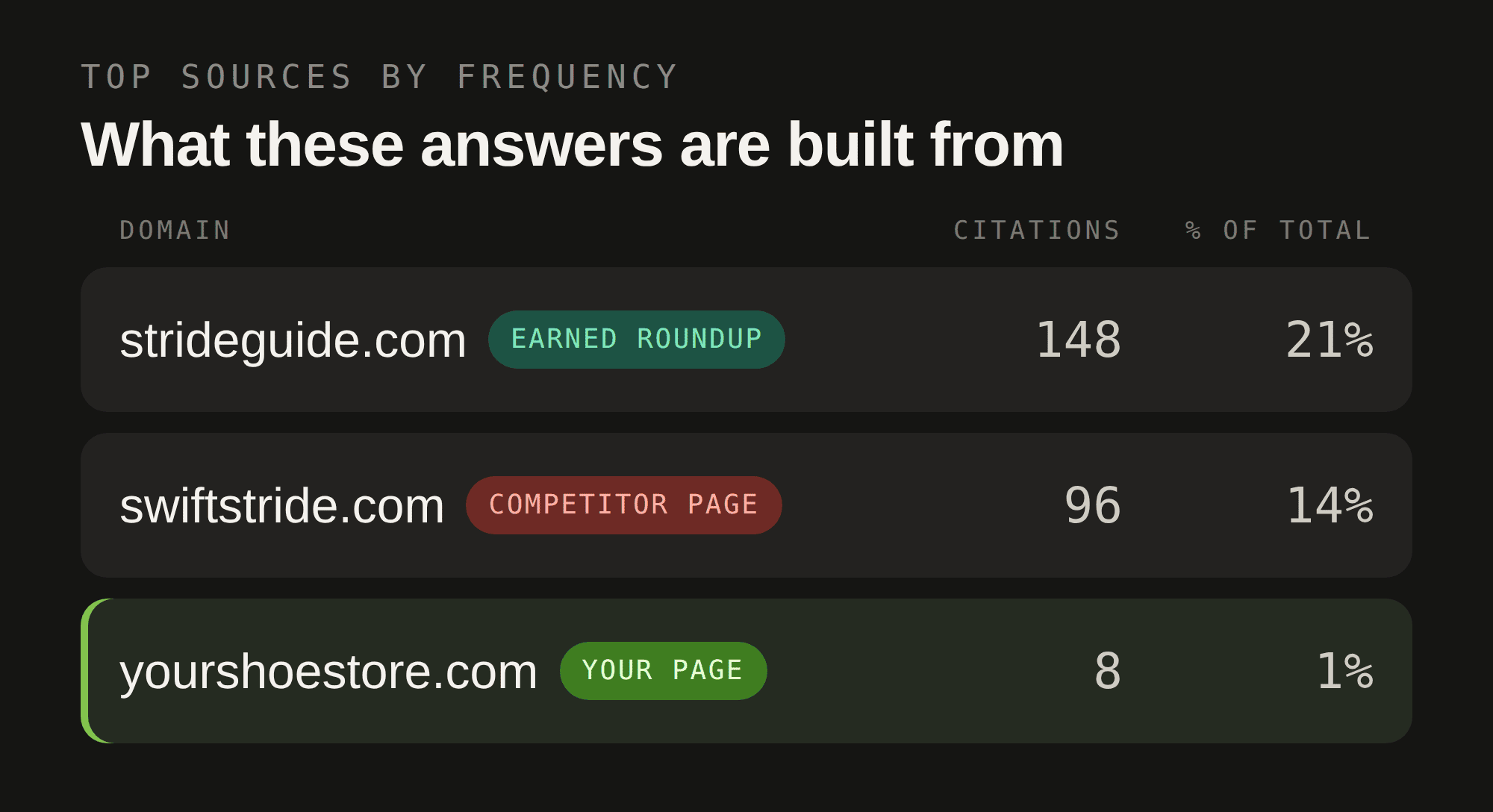
Most AI answers are generated from a short list of sources the model considers relevant for that question. In the example those were runnersworld.com, runrepeat.com, a YouTube review channel and zappos.com. MentionBird calls this list your target list, and it is the part most other tools skip.
Step 4: Get the Plan
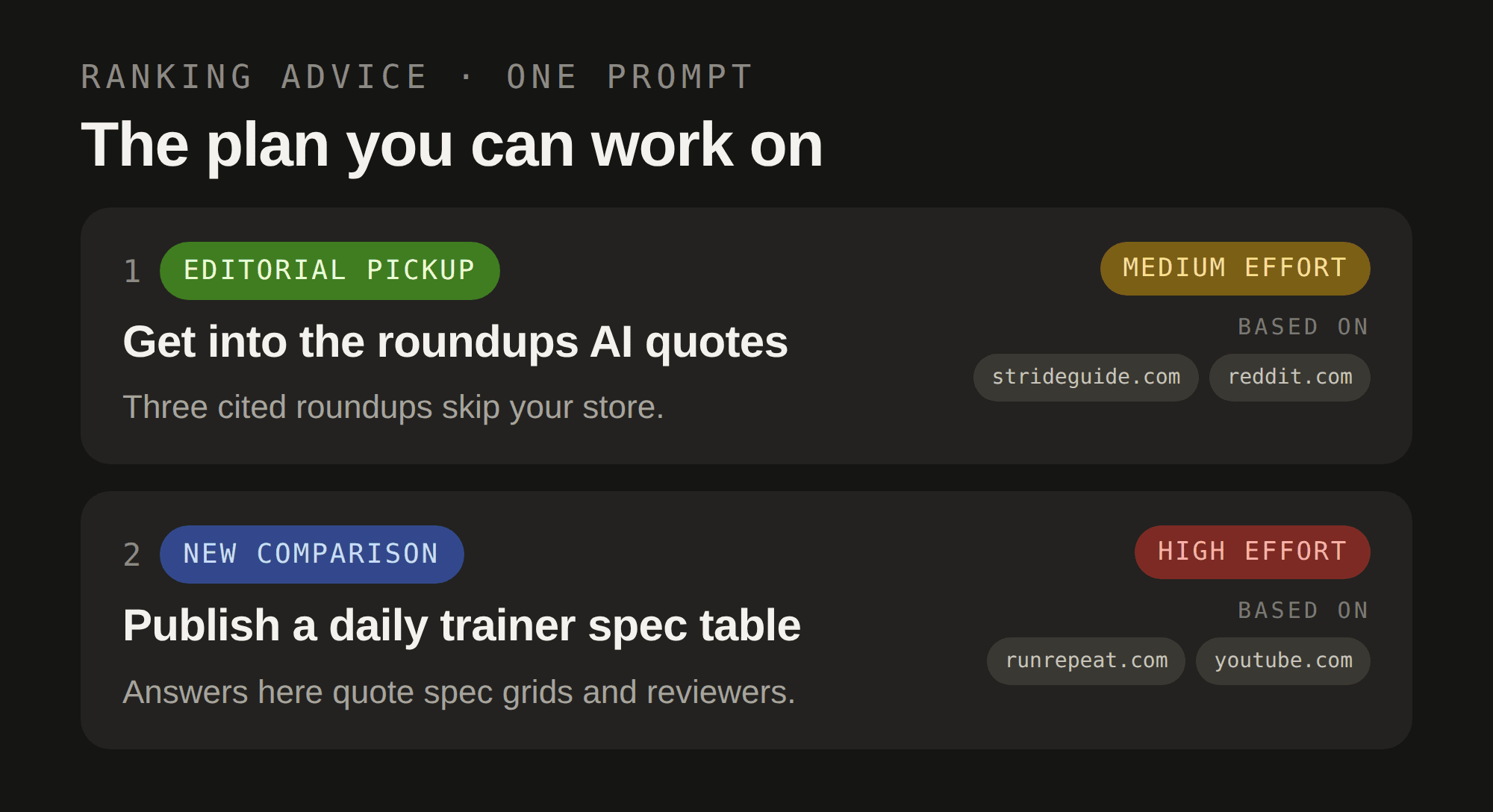
AI Ranking Advice turns the source map into ranked actions split by effort and impact. For the running shoe example: publish a daily trainer comparison guide with real testing detail (medium effort, owns the source), add fit, durability and use case detail plus comparison tables and schema to existing product pages (low effort, quick win), and pitch the publications, reviewers and YouTube channels AI already trusts (high impact, long term).
Step 5: Watch the Proof
Daily tracking shows whether visibility, citations and position change after each action. The site shows an illustrative example of a prompt going from not cited to position 2, 3 of 4 target sources won, plus 18 points of visibility share. It is clearly labelled as an example with results varying by category and effort, which I appreciated.
The timeline MentionBird suggests: week 1 gives you baseline scores, source maps and plans; month 1 is when page improvements go live and early citation changes appear on low difficulty prompts; month 3 is when earned mentions start showing up.
Core Features: The Heart of This Review
Prompt Tracking
What a Prompt Run Actually Is
This trips people up, so it is worth being precise. One run is one prompt, asked on one AI platform, once. Track "best running shoes for daily use" on ChatGPT and Gemini and that is two runs a day. Your allowance resets every morning and you choose the split, so you can go deep on high intent prompts and light on the rest.
Unused runs do not roll over. MentionBird's reasoning is that AI visibility tracking only works if the same questions get asked every single day, and rollover would break the daily series. Fair, but it means you should size your plan against the number of prompts you realistically want checked daily, not your peak curiosity.
The Metrics on Each Prompt Page
Per prompt you get:
- Share of mentions: how often the answer names you
- Mention rate and average position in the answer
- Prominence score: how high up in the answer you appear
- Your rank among the brands AI names, and a leaderboard of which brands appeared and how often
- Share of voice against competitors
- History and trends, up to 365 days
- The actual AI answers, readable in full
At the account level you also get a visibility score next to each competitor and a prominence score, so the numbers have context. The pricing page adds data freshness monitoring to the picture, which flags when an answer you are watching looks stale.
Funnel Stages and Prompt Research
MentionBird suggests tracking prompts from all three stages:
- Top of funnel: "Should I invest in running shoes for casual runs?" No brand is typed here, so if AI names one, that brand may enter the shortlist early.
- Middle of funnel: "Brand A vs Brand B, which makes better shoes?" Direct comparisons, and the positions buyers act on.
- Bottom of funnel: "Best running shoes for adults", where review sites and buying guides decide the leaderboard.
You can import prompts in bulk via CSV from keyword research, sales calls or support tickets. MentionBird also suggests prompts based on your brand, competitors and cited sources, and every prompt carries a difficulty score (1 to 10) and a search volume score (1 to 10) so you can pick gaps that are both winnable and worth winning.
Countries and Tags
Country targeting is included on every plan, so you see the answer a buyer in the US, UK, Germany or India actually gets rather than a global average. The global setting sends no location signal at all, which is worth knowing: it is not a worldwide average. Tags let you filter every report by brand, product, campaign or client.
Source and Citation Analysis
This is the feature I would point at first if you are comparing tools. For each prompt MentionBird breaks down:
- Which sites the answer was built from
- Your pages vs competitor pages vs earned coverage
- Source type breakdown: news, forums, review sites, docs
- Content format breakdown: listicle, comparison, how to, review
- Domain authority for every cited site
- Page level details for every cited URL
One distinction the ChatGPT page makes clearly: a mention is when the assistant names your brand in its reply, a citation is when it links or credits one of your pages as a source. You can be mentioned without being cited, and cited without being mentioned. Citations tend to hold longer because they tie the recommendation to a page rather than to whatever the model happens to recall.
AI Ranking Advice
How It Works
Pick a tracked prompt where you have low visibility, click get advice, and MentionBird's Answer agent reads the answer AI gave today, the brands named in it, and every source cited. Five agent credits per run. The plan is saved against the prompt with its full history, so re reading past advice never starts a new run, whether you read it in the dashboard or through the MCP server.
Worth noting: the agent checks the pages you already own before recommending anything new, so it does not send you to publish a guide you effectively already have.
The Three Moves
Every recommendation comes back as one of three:
- Create the source: launch what is missing, for example a comparison guide nobody in your category has made.
- Improve what exists: strengthen, reposition or expand a page you already own before adding anything new.
- Earn your way in: a target list of roundups, reviewer sites and forums, with the reasoning the agent used to rank them.
Why Per Prompt Matters
Site wide advice tells you to improve schema, content and authority. All true, none of it tells you whether this week's work changes the answer your buyer sees. Ask AI about daily trainers and it builds from four pages; ask about trail shoes and the list changes. MentionBird's bet is that the unit of work is one answer on one platform, and it is a bet I find convincing. The same prompt on two platforms usually returns two different plans, because each builds from different sources.
Each recommendation carries the real links the agent used, plus an effort estimate, so your team can check the reasoning before committing a week to it. There is also an agent that summarizes the YouTube videos AI is citing, at 1 credit per 5 minutes of video.
Competitor Benchmarking
You add competitors and MentionBird watches them inside your brand's reports rather than billing them as brands. If you are not sure who to add, the pricing page lists features for finding your competitors automatically and resolving a competitor's website, so the list does not have to be built by hand. Brand aliases, abbreviations and common misspellings are grouped under one tracked brand, so "MentionBird", "Mention Bird" and "mentionbird.ai" count as one. The result is a visibility share table showing weekly change per brand, plus the ability to trace any score change back to the exact prompt, model or citation that caused it.
AI Platform Coverage
| Platform | Starter | Growth | Custom |
|---|---|---|---|
| ChatGPT | ✅ | ✅ | ✅ |
| Gemini | ✅ | ✅ | ✅ |
| Perplexity | ❌ | ✅ | ✅ |
| Claude | ❌ | ✅ | ✅ |
| Grok | ❌ | ❌ | ✅ |
| Google AI Overviews | ❌ | ❌ | ✅ |
| Microsoft Copilot | ❌ | ❌ | ✅ |
| DeepSeek | ❌ | ❌ | ✅ |
For ChatGPT specifically, MentionBird runs each prompt in both web search and model only modes, because the same question can name different brands depending on whether the assistant searches or answers from training. That is a detail most tools ignore.
Free Tools
Three no login tools, worth running before you pay anything:
- AI Crawler Accessibility Checker: a report card of which AI crawlers can reach your site, tested against 14 user agents grouped by what they actually do. The retrieval group, the one that grounds live cited answers, covers OAI-SearchBot, Claude-SearchBot and PerplexityBot. User triggered fetches cover ChatGPT-User, Claude-User and Perplexity-User. Training crawlers cover GPTBot, ClaudeBot, CCBot, Bytespider, Meta-ExternalAgent and Amazonbot. Two opt out tokens, Google-Extended and Applebot-Extended, have no crawler behind them. Results are cached per domain for 24 hours.
- AI Content Score: paste a URL for a 0 to 100 quotability score built on eight weighted checks, with the highest impact fixes ordered. Pages are fetched, scored and discarded, not stored.
- Keyword to AI Prompt Generator: enter a brand, URL or category keyword and get around 10 brand neutral prompts people actually type into ChatGPT, Gemini, Claude and Perplexity.
Two details I respect. The retrieval group is the one that matters for citations, and blocking training crawlers is a separate decision with separate consequences. Also, Google AI Overviews is governed by Googlebot and Microsoft Copilot is fed by Bingbot, so neither has a dedicated agent to test.
On privacy: MentionBird says it does not store the pages you check and does not use anything you submit to train models. Two requests do reach third parties, though: pages needing JavaScript are fetched through Jina Reader, and the prompt generator sends your input to Perplexity's API.
If your score is low or bots are blocked, MentionBird's own advice is to fix access first: check robots.txt, then CDN rules, firewalls and bot protection upstream of it, and mind the spelling, since a rule written against "GPT-Bot" instead of "GPTBot" silently does nothing. Allow 24 hours before re-running the checker, since verdicts are cached.
MentionBird Pricing
| Starter | Growth | Custom | |
|---|---|---|---|
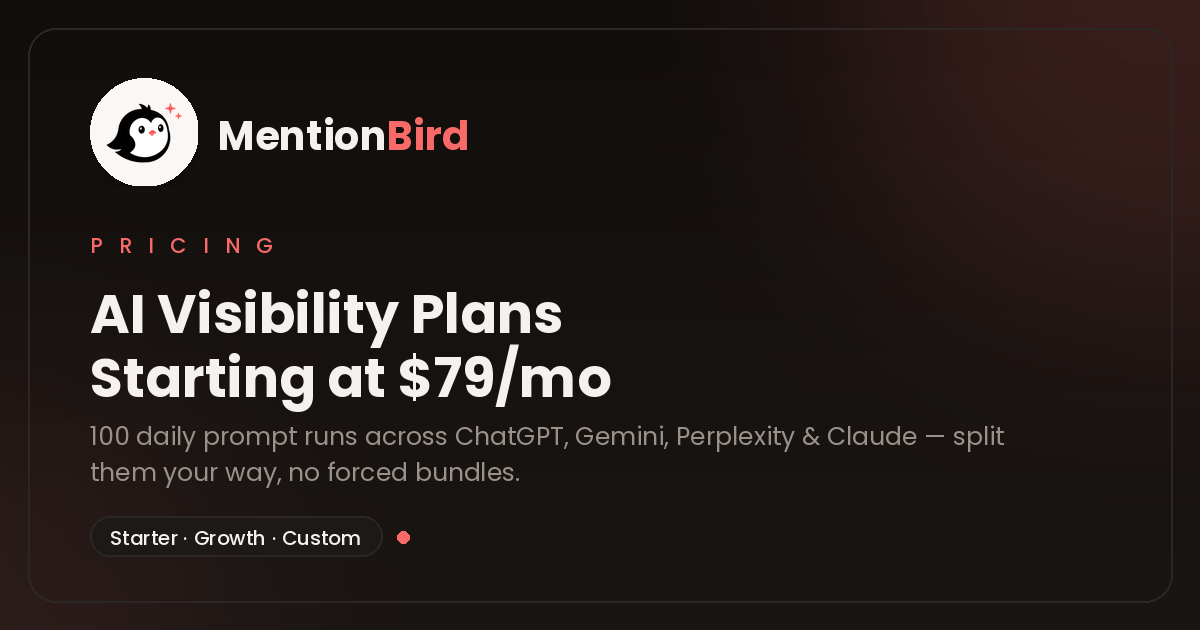
| Monthly | $79 | $299 | Let's talk |
| Annual | $66/mo ($790 billed) | $249/mo ($2,990 billed) | Custom quote |
| Daily prompt runs | 100 | 400 | Unlimited |
| Prompts you can add | 100 | 400 | Unlimited |
| AI platforms | ChatGPT, Gemini | + Perplexity, Claude | All 8 |
| Brands tracked | 1 | 3 | Unlimited |
| Competitors per brand | 5 | 10 | Unlimited |
| Team members | 10 | 10 | Unlimited |
| Agent credits per month | 100 | 500 | Custom |
| Dedicated account manager | ❌ | ❌ | ✅ |
Add ons: 50 extra daily runs for $49/month, stackable as many times as you need, and 500 extra agent credits for $99 (about 100 ranking plans).
A few things worth knowing before you sign up:
- There is no free trial and no free plan. Every crawl and prompt run costs MentionBird money, including trial runs, so access stays paid to prevent abuse.
- Use code TRY19 at checkout and your first month of Starter is $19 instead of $79, with the full plan included. It renews at $79 and you can cancel anytime.
- Annual plans are priced at 10 months instead of 12, so you get 2 months free.
- No contract. Cancel monthly or annual anytime, and access runs to the end of the paid period.
- Upgrades apply immediately, downgrades at the next cycle, and prompts, tags, history and reports all carry over.
Reading the credit maths: one ranking advice run costs 5 credits, so 100 credits is roughly 20 plans a month on Starter and 500 credits is around 100 plans on Growth. If you want advice on 30 prompts across 2 platforms, you will burn through Starter credits quickly.
What MentionBird Does Not Do
Being clear about this saves disappointment:
- It does not write your content or run your outreach. The agents identify the pages, publications, reviewers and YouTube channels that matter. The publishing, fixing and pitching stay with you or your agency.
- It is not an SEO rank tracker. It tracks brand mentions in AI answers, not webpage positions for keywords. You can rank well on Google and still be missing from the answer.
- It does not install anything. No code, plugin or tracking tag, and it needs no access to client sites or analytics to start tracking.
- It cannot change the model. You change what the model reads, not the model itself.
- Results are not guaranteed. The company is explicit that its numbers are illustrative and vary by category and effort.
MentionBird Pros and Cons
What I like:
- The source map is the differentiator. Knowing which four pages built an answer is far more actionable than a mentions chart.
- Advice is scoped to one prompt on one platform, with the links the agent used and an effort estimate you can argue with.
- Advice is stored against the prompt, so re-reading it never costs more credits.
- Runs are a single pool you split however you like across platforms and prompts.
- Country targeting, tags, CSV import and export, and the MCP connection are on every plan, not locked to the top tier.
- The three free tools are genuinely usable without an account, and the crawler checker alone can find a blocked bot you did not know about.
- No installation, no site access, so an agency can start tracking a client the same day.
What I would flag:
- No free trial, only a discounted first month, so you commit before you see the dashboard.
- Prompt runs do not roll over, which makes plan sizing matter more than usual.
- Agent credits are separate from runs. Starter's 100 credits is around 20 plans a month, which a busy team can exhaust.
- Four of the eight AI platforms, including Google AI Overviews and Copilot, only appear on the custom tier.
- Growth caps you at 3 brands, so agencies with more clients need a custom quote.
- It tells you what to do but does not do it, which is deliberate, though some buyers will expect execution.
- The 20 to 50 prompt guidance means a large catalogue cannot be tracked exhaustively on the lower tiers.
Setup and Requirements
Genuinely light. Add your brand, prompts and competitors, pick platforms and countries, and tracking starts. No code, no plugin, no DNS change, no site access. MentionBird reads AI answers from the outside and updates your data once every 24 hours, and you can trigger a manual run whenever you want fresher results.
MentionBird vs Typical Alternatives
| Capability | Typical AI visibility trackers | SEO rank trackers | MentionBird |
|---|---|---|---|
| Tracks each prompt daily | ❌ Often weekly or sampled | N/A | ✅ Daily, per prompt, per platform |
| Shows sources behind the answer | ❌ Rarely | ❌ | ✅ With domain authority and page details |
| Per prompt fix plan | ❌ | ❌ | ✅ AI Ranking Advice, 5 credits per run |
| Effort and impact estimates | ❌ | ❌ | ✅ |
| Difficulty and volume per prompt | ❌ | ✅ Volume only | ✅ Both, 1 to 10 |
| Country specific prompts | ⚠️ Sometimes | ✅ | ✅ On every plan |
| Competitor share of voice | ✅ | ❌ | ✅ |
| 365 day history | ⚠️ Varies | ✅ | ✅ |
| Multi platform coverage | ⚠️ Varies | N/A | ✅ Up to 8 |
| Connects to Claude or ChatGPT | ❌ | ❌ | ✅ MCP server |
| No installation needed | ✅ | ✅ | ✅ |
MentionBird also publishes comparison pages against Profound, Otterly, Peec AI and the Semrush AI Toolkit, so it is comfortable being evaluated side by side with the bigger names.
Who Should Use MentionBird
- SaaS companies that keep losing deals to a competitor buyers "found on ChatGPT"
- Ecommerce brands that live and die by roundups and buying guides
- Local service businesses where the assistant recommends whoever it can find
- AEO and SEO teams that need to prove visibility moved, prompt by prompt
- Agencies managing several clients, who need a defensible audit in week 1 and a progress report in month 1
The agency workflow is worth calling out. Because MentionBird needs no site access, you can start tracking a client the day they ask the awkward question. The ranking plan becomes the estimate and the work list at the same time, and the daily record becomes the proof. Just note the brand limit: 3 brands from Growth, custom quote beyond that.
What Users Say
Quotes published on the MentionBird site:
- Ashish Manchanda, Founder & CEO: "Turns out we win the category questions and lose the comparison ones, which is exactly backwards for a buying decision. MentionBird is what made that visible to me."
- Rohit Raveendran, Co-founder: "We knew engineering buyers were asking AI which tools automate environment provisioning. MentionBird showed us the exact questions we were invisible on, so we went and answered them."
- Hardik Vishwakarma, Co-founder & CEO: "AI was recommending an ATS to every buyer who asked. Just never ours. MentionBird showed me that prompt by prompt, which made it obvious what we had to go fix first."
- Kabandi Saikia, Co-founder: "When AI names us, we land near the top. It just only names us in half the answers. That's a very different problem to fix, and MentionBird is what showed me."
- Valsaraj Raj, Founder: "We have 3300+ reviews and AI still wasn't recommending us. MentionBird showed me the exact questions where that was happening, so we could actually go fix it."
- Niwin Santhosh, Co-founder: "Merchants ask AI for alternatives to the category leader. We're in 83% of those answers now. MentionBird found the gap and told us exactly what to fix first."
The pattern across all six is the same: the useful thing was not the score, it was finding out which specific questions they were invisible on.
MentionBird FAQ
What is an AI visibility tool? It tracks where, how often and how prominently a brand appears in AI generated answers, whether those answers describe the brand accurately, and which websites the assistant cites. Some tools, MentionBird included, go further and give advice on how to earn more mentions.
Which AI platforms does MentionBird track? ChatGPT, Gemini, Perplexity, Claude, Grok, Google AI Overviews, Microsoft Copilot and DeepSeek. Which ones you can use depends on your plan.
How many prompts should I track? The company suggests 20 to 50 real buyer questions to start, noting that a focused set of pre purchase questions beats hundreds of broad prompts. You can add, label or regroup prompts anytime.
Do I need to install anything on my site? No. No code, plugins or tracking tags. Add your brand, prompts and competitors and MentionBird checks AI answers without touching your website.
How is this different from SEO rank tracking? SEO rank trackers show where a webpage sits in Google results. MentionBird checks whether AI answers mention your brand for the questions buyers ask, which sources those answers cite, and how you compare with competitors.
How often is data updated? Once every 24 hours, and you can start a manual run anytime.
Can I track competitors and multiple brands? Yes. Competitors are tracked inside your brand's reports and do not count against your brand limit. Multiple brands or product lines can live in one workspace, organized with tags.
Can I change my plan later? Yes. Upgrades apply immediately, downgrades start with your next billing period, and your prompts, labels and past data stay available.
Is there a free trial? No. Instead, code TRY19 makes your first Starter month $19 rather than $79, with the complete plan included.
Does MentionBird write the content or do the outreach? No, and the company is explicit that this is deliberate. It identifies the pages, publications, reviewers and YouTube channels that matter. Your team or agency does the publishing, fixing and pitching.
What is the difference between a prompt run and an agent credit? A run is one prompt asked on one platform once, refreshed daily. A credit pays for agent work, and 5 credits buys one ranking plan for one prompt on one platform. Runs reset daily, credits refresh monthly, and neither rolls over.
Can an agency run several clients from one account? Yes. Growth covers 3 brands with 10 competitors each, all in one workspace with tags for separation. Beyond that you need a custom quote.
Does appearing in AI answers actually affect sales? MentionBird's answer is that recommendations shape which brands buyers consider, since a buyer may only visit the brands named in the answer. If you are missing, a competitor reaches that buyer first. That is the bet the whole product rests on.
Final Review Verdict: Is MentionBird Worth It?
The AI visibility category has a sameness problem. Most tools give you a score, a mentions chart and a weekly email, and then leave the actual work to you. MentionBird's real contribution is the layer underneath the chart: for each prompt you are losing, here are the four pages the answer came from, and here is what to do about them, with the links and an effort estimate. That is a much shorter path between a number going down and a ticket being filed.
The trade offs are honest ones rather than hidden ones. Prompt runs do not roll over, so you have to size your plan against daily volume. Agent credits are separate from runs, and 100 credits on Starter is around 20 plans a month, which a busy team can exhaust. Four of the eight AI platforms sit behind the custom tier, which is a bigger jump than the tidy $79 to $299 ladder suggests. And there is no free trial, only the discounted first month.
None of those change the core value. If buyers in your category ask assistants what to buy, and you currently have no idea what those assistants say about you, this is one of the more practical ways to find out and then do something about it. Start with the three free tools, take the TRY19 month, and give it the 20 to 50 prompts that actually drive revenue.
Review Summary
- Ease of Setup: ⭐⭐⭐⭐⭐ (5/5)
- Prompt Tracking Depth: ⭐⭐⭐⭐⭐ (5/5)
- Source and Citation Analysis: ⭐⭐⭐⭐⭐ (5/5)
- AI Ranking Advice Usefulness: ⭐⭐⭐⭐☆ (4.5/5)
- Platform Coverage: ⭐⭐⭐⭐☆ (4/5)
- Reporting and Benchmarks: ⭐⭐⭐⭐☆ (4.5/5)
- Pricing Transparency: ⭐⭐⭐⭐☆ (4/5)
- Value for Money: ⭐⭐⭐⭐☆ (4/5)
- Overall Review Score: ⭐⭐⭐⭐☆ (4.5/5)
Curious what AI says about your brand? 👉 Try MentionBird for $19 in your first month with code TRY19, or run the free crawler, content score and prompt generator checks first to see where you stand.
Tags
# Review# MentionBird# AI visibility tool# AI search visibility# Answer engine optimization# AEO tool# Prompt tracking# AI Ranking Advice# ChatGPT brand tracking# Perplexity tracking# Gemini tracking# AI mentions tracking# AI citation analysis# Share of voice# Competitor benchmarking# AI visibility score# GEO software# AI search optimization# Marketing analytics software# Agency client reporting# Keyword to prompt generator# AI crawler accessibility checkerJSON Support Review - Free JSON to Excel Conversion, No Signup
ConferenceGrid Review - See Every Conference a Company Touches
Follow for new blogs
Subscribe to our blog
Subscribe to Newsletter
Subscribe to our newsletter to get the best products weekly.